
Sustainability: HR initiatives
WingArc1st's Human Rights Policy
Related goals
WingArc1st's Human Rights Policy
Under our corporate vision, "Empower Data, Innovate the Business, Shape the Future", we position respect for the fundamental human rights of all people as the foundation of our corporate activities. Based on internationally recognized human rights standards, we respect the human rights of all stakeholders and contribute to the realization of a sustainable society.
- 1.Commitment to international frameworks
Our company will maintain high ethical standards based on the UN Guiding Principles on Business and Human Rights, the International Bill of Human Rights, and the ILO's core labor standards. - 2.Scope
This policy will apply to WingArc1st Inc. and its group companies both in Japan and overseas. Additionally, we will share our commitment to respecting human rights with all stakeholders involved in our business activities, including employees, business partners, customers, and local communities, and promote collaboration. - 3.Key focus areas
Our company will not discriminate on the basis of race, gender, age, religion, disability, sexual orientation, or any other grounds, and treat all people fairly. In accordance with ILO standards, we will not tolerate forced labor or child labor and maintain a healthy working environment. We will prohibit harassment such as sexual harassment and power harassment, establish a confidential reporting channel for consultations and reports, prohibit retaliation against whistleblowers, and promote employee understanding through regular training. We ensure occupational safety and health and protect the physical and mental well-being of our employees. We will establish a system to reflect employee opinions in management through worker representatives elected in accordance with the Labor Standards Act, and strive to improve the working environment through dialogue. - 4.Response to supply chain issues
We share our policy on respecting human rights with our suppliers and request their understanding and compliance. We have established a contact point to receive inquiries and feedback from our business partners. We will strengthen our initiatives to uphold human rights by establishing a system for identifying and assessing human rights risks in the procurement process and, where necessary, request improvements. - 5.Due diligence for human rights
Our company will carry out continuous due diligence for human rights to identify, prevent, and mitigate adverse impact to human rights, and will disclose the status of these efforts on our website and other channels. - 6.Remedial measures
In the event of any human rights violations, we will take prompt and appropriate remedial measures and strive to prevent recurrence. - 7.Discussions with stakeholders
We place importance on discussions with our stakeholders, including employees, business partners, and local communities, and will continuously improve our efforts to uphold human rights. - 8.Publication and review of policies
We will publish this policy on our website and periodically review it in response to changes in the social environment and our business activities.
Established on 16 June, 2021
Revised on 26 November, 2025
WingArc1st Inc.
President, Executive Officer and CEO Jun Tanaka
There were no violations of laws and regulations, such as human rights violations, in FY2024.
For details on prior years, please refer to the Human Capital Report.
■WingArc1st's Privacy Policy
Due diligence for human rights
We are committed to upholding human rights in accordance with the United Nations' Guiding Principles on Business and Human Rights, as stated in our Human Rights Policy. To this end, we implement the following due diligence measures for human rights.
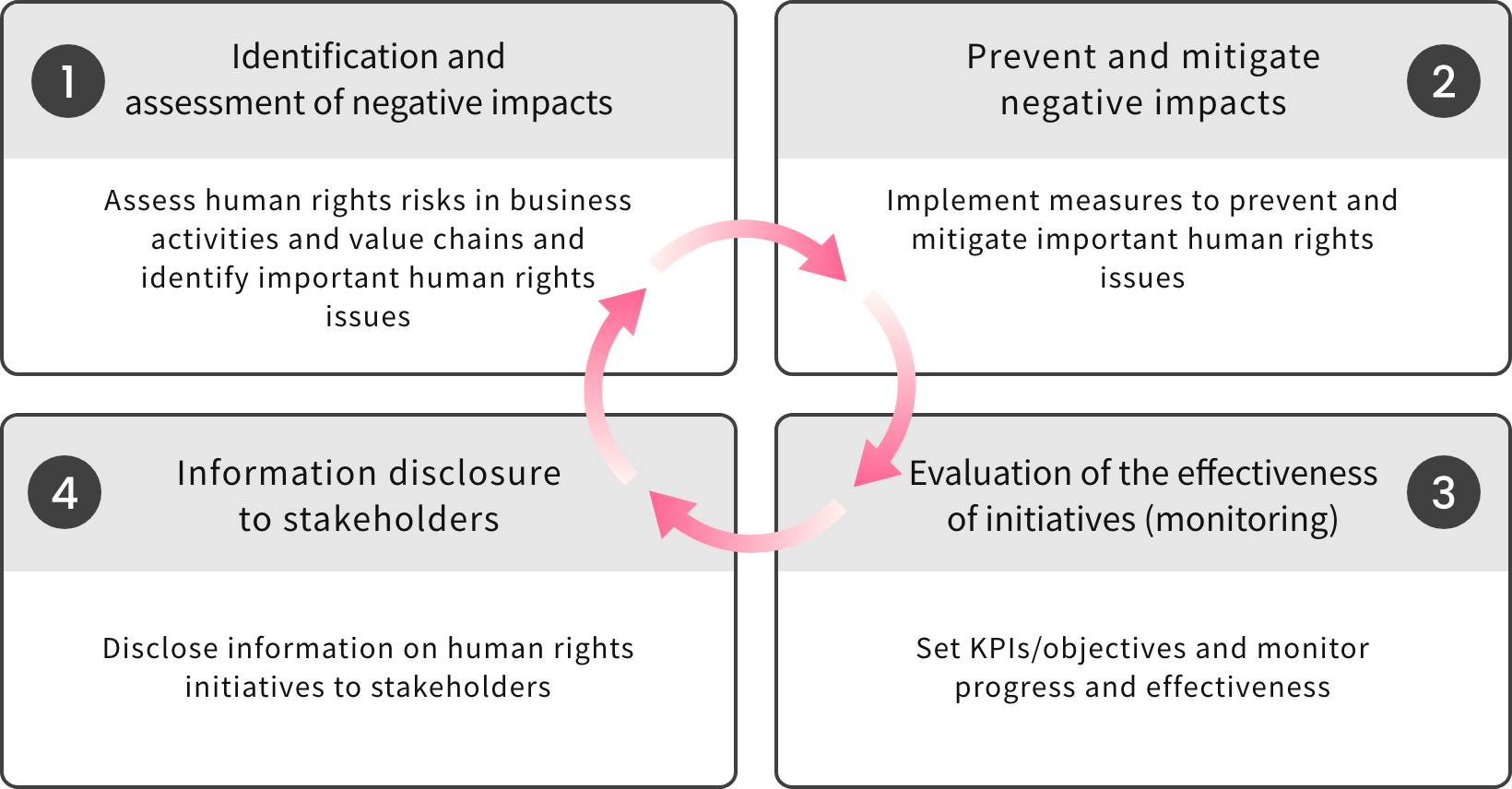
Human rights risk assessment
As our first step in due diligence for human rights, we conducted the following human rights risk assessment based on the results of interviews with the managers of relevant internal departments, and with the advice of external experts, and identified key human rights issues.
- Critical human rights risks
- Important human rights risks
| Severity | High | |||
|---|---|---|---|---|
| Mid |
|
|
||
| Low | (Working conditions, discrimination based on nationality, human rights violations by AI, and so on*) |
|
|
|
| Low | Mid | High | ||
| Likelihood | ||||
*Numerous human rights risks are assessed at this level, with some listed collectively.
Response to important human rights issues
Regarding the identified critical human rights issues, we are advancing our efforts by establishing the following response strategies, primarily through the Risk and Compliance Committee.
| Human rights issues | Direction of response | |
|---|---|---|
| Framework construction |
|
|
| Important human rights issues | Workplace harassment |
|
| Long working hours |
|
|
| Gender discrimination |
|
|
| Human rights violation through advertising expressions |
|
|
| Human rights violations against business partners |
|
|
| Occupational health and safety |
|
|
| Privacy policy (consumers) |
|
|
